
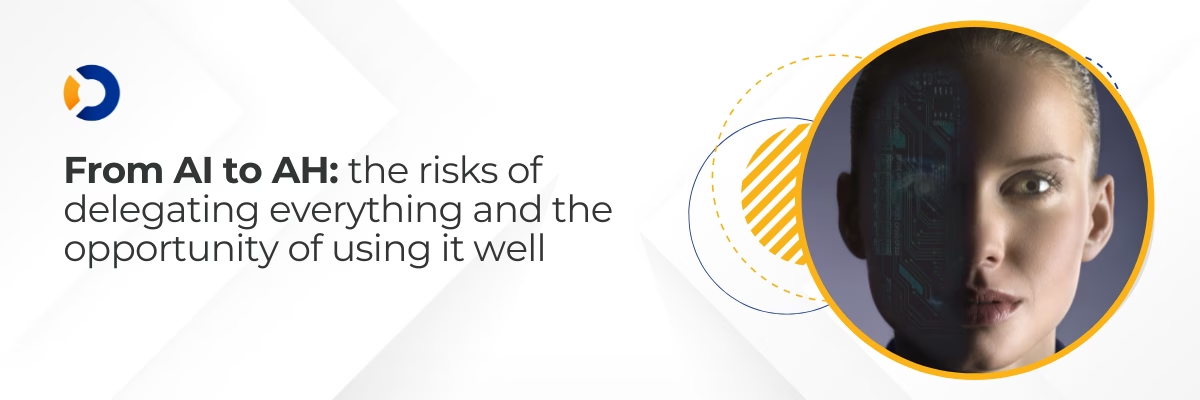
“Loss of critical thinking.” “Blind trust in the results.” “A rented identity.” “A prosthesis for human existence.” The warnings about artificial intelligence come from different disciplines and point in the same direction: when AI goes from being a resource to being in everything, the cost is an Artificial Humanity (AH).
Yuval Noah Harari¹ anticipated it back in 2024: “Knives and bombs do not themselves decide whom to kill. They are dumb tools, lacking the intelligence necessary to process information and make independent decisions. In contrast, AI can process information by itself, and thereby replace humans in decision making. AI isn’t a tool, it’s an agent.”
Late this past May, comedian Ronny Chieng² stood in front of Harvard graduates and, between shouts, told them: “A lot of other respected graduation speakers around America are talking about you guys needing to master AI for the future. I’m here to tell you the mission of your generation is to destroy AI. Kill it! AI is just going to end up making mediocre people dumber.”
There are also more measured positions. Speaking with IPFone, Fredi Vivas³, systems engineer and professor specialized in AI, argues that the key is understanding what a machine is good at, what a human is good at, and how they complement each other. “The idea is to have a mindset of augmentation, of growth: what things I can’t do today but could with AI.” In short, it’s about expanding human capability.
One of the fields where it delivers strong results is deep customer understanding. In a market where brand loyalty is nothing like it was 20 or 30 years ago, he explains, that predictive capacity to analyze large volumes of data makes the difference.
When does AI go from supporting us to shaping who we are?
In line with Harari’s view, sociologist Ana Castellani⁴ argues that AI is not a tool in the traditional sense of the word. “AI can make decisions on its own, improve itself, hallucinate. That’s why it has strong implications for the relationship it establishes with humans.”
Joan Cwaik⁵, professor and technology author, points out that the line is crossed when, instead of using AI for a task, you use it to avoid thinking. The exact moment is when “you outsource your doubt.” “At first, you ask it to summarize a text. Then, to tell you what to think about it. And one day you ask it to tell you what to feel.”
According to psychologist Pablo Melicchio⁶, when technology becomes a permanent fixture, “like a prosthesis for human existence,” rather than an occasional resource, it starts to function as a dependency. Most significantly, it “shuts down critical thinking,” and the user starts taking everything it produces as absolute certainty.
What consequences does AI bring on a psychological, sociological and identity level?
The effects vary across generations, social classes and each individual’s mental health. “It’s all still unfolding, with several studies underway on the cognitive and psychological effects, but I believe the speed of those effects is far greater than our speed to research them,” the sociologist notes.
When AI is so deeply embedded in daily life, human connection becomes harder, Melicchio warns. Critical thinking and personal perspective fade, while insecurity, intolerance and the expectation of immediacy grow.
And there is also, he adds, the identity dimension: if AI can do everything for me, the questions of self-knowledge, “who am I, what am I good for,” lose the only real path to an answer, which is a search built from within. “Instead of AI becoming part of your life, you end up becoming part of the AI.”
For Cwaik, when you delegate to a model the parts where it used to show who you were, the result is no longer yours and looks the same as everyone else’s: while we believe we’re becoming more original, we’re becoming increasingly alike. “Identity has always been built by choosing what to say, what to leave out, which word to use and which one not to. If someone else makes that choice, what you’re left with is a rented identity.”
Are there uses of AI that should remain exclusively human?
Medical and psychological care, according to Castellani, should stay solely in human hands. Melicchio agrees and reinforces the point from clinical practice: therapeutic work is singular; every conflict has a root, and there are no shortcuts. He also stresses that certain activities depend fundamentally on encountering other human beings.
“It worries me that it writes the condolence letter. That it drafts the wedding vows. That it sends the apology message after a fight. Effort, in those cases, is not a flaw,” Cwaik reflects, adding: “In relationships, the effort is the message. The day we automate ‘I miss you,’ we don’t gain time. We lose the meaning of saying it.”
What stance should individuals and companies take in this context?
“One of great responsibility,” says Castellani, firmly. She argues that companies must train their teams not only in how to use AI, but in the ethical dilemmas it raises, in how it’s built, and in the class, gender and ethnic biases embedded in it. “The greatest responsibility” lies with governments, which should implement regulatory frameworks to “mitigate the risks.”
Melicchio proposes recovering and prioritizing the human side: “We are social beings who define ourselves in relation to what is social.” Any AI should be a tool that adds one more element, but always in service of “reflecting with each person’s own imprint.”
Cwaik is precise about the individual limit: it’s perfectly fine for AI to take busywork off your plate, but what you cannot outsource is your judgment, your voice and your way of seeing the world.
Conclusion
So, how should we position ourselves in this context? Among the most critical risks, Vivas warns about blind trust in the results, the loss of one’s own voice, and the exposure of sensitive data in tools without proper security protections.
But he also stresses the opposite risk: “One risk is not using AI and missing an opportunity. Because that’s what it really represents today: an opportunity to grow, to do things better, to be more relevant to customers.”
At IPFone, we sell and promote the use of AI for business, fully aware of the risks of using it the wrong way. We’re taking part in this debate: can artificial intelligence end up producing an artificial humanity?
We believe it doesn’t have to be that way. Technology applied well, and responsibly, strengthens what people can do, and it also improves the conditions for what is human to develop and thrive.
Our company applies AI where it makes sense: managing volume with quality, reducing operational friction, and freeing up time so the people behind the business can focus on what truly matters. That is, the work that requires human judgment, empathy and real presence.
***
Sol Narosky is a journalist and content marketing specialist with over six years of experience covering technology, innovation, and emerging digital trends.
Sources:
- Yuval Noah Harari, Nexus: A Brief History of Information Networks from the Stone Age to AI, Penguin Random House, 2024
- Ronny Chieng, Harvard Class Day speech, 2026. Available at: https://www.youtube.com/watch?v=ORq_Hi5dB-g
- Fredi Vivas, CEO of RockingData, engineer and professor specialized in AI. Author of the books “Generación IA,” “Invisible” and “¿Cómo piensan las máquinas?”
- Ana Castellani, sociologist and director of the Observatory of Elites at CITRA
- Joan Cwaik, author, professor and technology communicator. He has published five books, most recently “El Algoritmo,” which explores how technology shapes our identity and our way of thinking. He teaches at Universidad de San Andrés, writes columns for Perfil and El Observador, and has given more than 500 talks in over 20 countries, including three TEDx talks
- Pablo Melicchio, psychologist (UBA) specialized in psychoanalysis, and writer