
Discover key AI communication stats and see how Artificial Intelligence can help you boost productivity, cut support costs, and transform customer service in 2026.
Just a few years ago, talking about Artificial Intelligence (AI) in business communication felt almost futuristic. Today, it’s a reality for companies of all sizes: AI handles routine work such as managing emails, calls, and support requests so teams can focus on tasks that genuinely require human attention.
As we move into 2026, the question is no longer whether businesses should use AI. The data is clear: AI-powered communication is already saving organizations time, money, and frustration, and tools like IPFone’s AI Voice Agents are becoming part of a modern setup because they support people, not replace them.
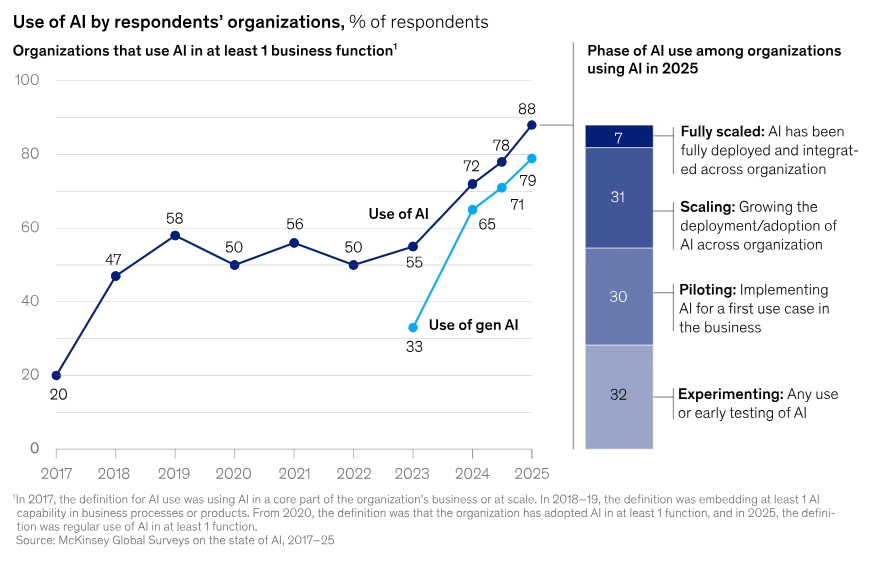
AI adoption in at least one business function continues to rise. According to McKinsey’s 2025 data, 88% of companies now report using AI regularly—up from 78% in 2024 and 55% in 2023. The same research also shows strong interest in AI agents, with 62% of organizations at least experimenting with them.
Time savings with AI
When it comes to time savings, recent surveys are now quantifying the impact of AI at work.
- Microsoft’s 2024 Work Trend Index reports that 75% of employees already use AI at work, and 90% of those users say it helps them save time and focus on more important tasks.
- Large workforce surveys are also quantifying daily gains. The Adecco Group’s 2024 Global Workforce of the Future study shows that employees who use AI save on average one hour per day. Around one in five say AI saves them up to 2 hours a day, and a smaller group reports gains of 3 to 4 hours daily.
- Thomson Reuters’ 2024 Future of Professionals report adds a longer‑term view: professionals expect AI to free up to 12 hours per week within five years, and most believe it will have a high or even transformational impact on their work, with 78% already seeing AI as a force for good in their profession.
Cost benefits
On the cost side, leading companies are already seeing meaningful financial impact.
- According to BCG’s 2025 report The Widening AI Value Gap, organizations that are considered “future-built” for AI are already realizing significantly higher financial impact than their peers. These leading organizations expect 40% greater cost reductions by 2028 in the business areas where they apply AI, compared with companies that are moving more slowly.
- Their early and strategic adoption of AI not only lowers operational costs but also accelerates growth: BCG’s analysis shows that future‑built companies are already achieving around 1.7× higher revenue growth, 1.6× higher EBIT margins, and 3.6× higher three‑year total shareholder returns than laggards.
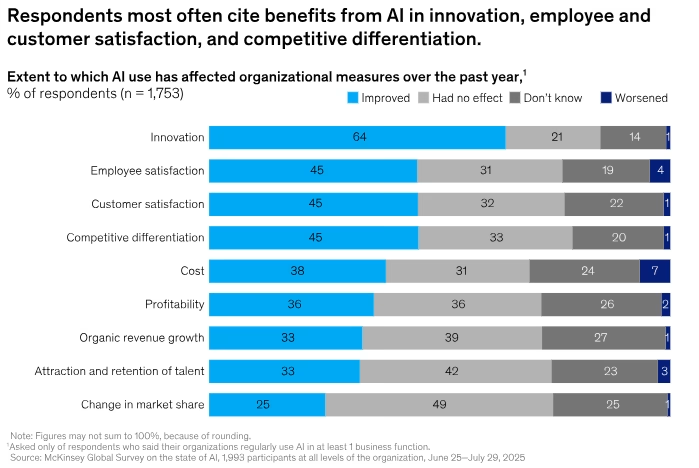
- McKinsey’s State of AI 2025 report reaches a similar conclusion: while only 39% of companies currently attribute any share of their EBIT to AI—and most of those say it is still under 5%—many are already reporting concrete cost benefits from specific AI use cases in areas like software engineering, manufacturing, and IT, alongside improvements in innovation and customer satisfaction.
Productivity and Frustration Reduction
AI is already delivering measurable gains in customer service productivity and helping reduce frustration for both customers and agents.
- According to Jabra’s Intelligent Contact Center Report 2025, contact centers using AI-driven routing and agent-assist tools reported reductions in average handle time (AHT) of up to 40%, alongside up to 30% improvements in issue-resolution rates, indicating both faster resolutions and higher effectiveness.
- Jabra’s findings also show that many contact centers are seeing a 20–30% boost in agent productivity, thanks to automating repetitive tasks and freeing agents to focus on more complex or value-added interactions.
- Beyond speed, many AI-enabled deployments are also showing improvements in customer-experience metrics: for example, some organizations report up to a 20% increase in customer satisfaction (CSAT) after deploying real-time AI support and quality-assurance tools.
All the numbers point in the same direction: AI is reshaping how businesses communicate, helping teams work smarter and giving customers the faster, more personalized experiences they expect. IPFone makes that shift simple. By adding AI Voice Agents and Conversation Intelligence to your existing setup, you can improve efficiency, support your team, and stay available 24/7 – without losing the human touch.
In 2026, adopting AI isn’t just about keeping up – it’s about choosing a better, more efficient way to support the people who rely on your business. If you want to see how this works in practice, you can book your free demo to explore what an AI Voice Agent could do for your team.
***
Sol Narosky is a journalist and content marketing specialist with over six years of experience writing about technology, innovation, and digital trends.