
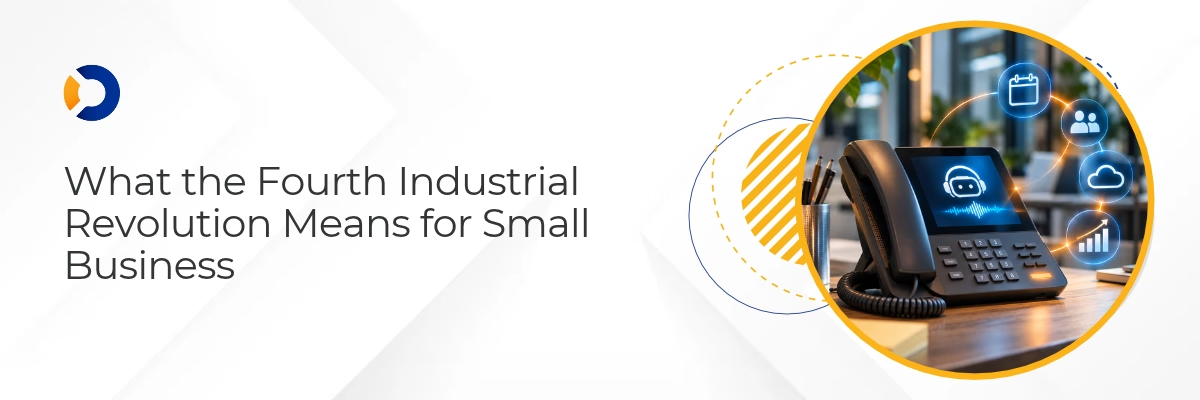
Compare your front desk today with a few years ago: a lead who calls after hours still gets an answer, spam calls no longer reach your team, and customer conversations turn into searchable notes. You end the day without having answered every call and tracked every follow-up yourself. That’s the fourth industrial revolution showing up in a small business.
Also called Industry 4.0, it’s the stage where AI, automation, cloud software and data work together inside everyday tools. Day to day, the most visible change is how tasks get divided: software takes on repetitive steps like booking appointments, sending reminders and logging customer details, so your team has more time for decisions and customers.
What Is the Fourth Industrial Revolution?
The fourth industrial revolution is the name the World Economic Forum popularized for the current wave of technological change, which its founder described as a fusion of technologies blurring the lines between the physical, digital and biological worlds¹.
For business owners, the relevant part is access. Tools that once needed a large IT budget now run in the cloud for a monthly fee, and some providers, like IPFone, handle the setup for you. If the vocabulary feels new, start with our guide to the AI terms you actually need to know.
How Does the Fourth Industrial Revolution Affect Small Businesses?
You’ll see it first in your team’s daily tasks. Employers surveyed by the World Economic Forum expect nearly 40% of workers’ core skills to change by 2030. AI and big data, networks and cybersecurity are among the fastest-growing skills, while human strengths like analytical thinking, resilience and flexibility stay at the core².
In a small office, the phone is a common starting point. The same questions about hours and pricing add up. An AI receptionist can answer those questions, route calls and take messages, so your team can focus on customers who need a person.
Danielle Kohle, COO of Coastal Energy Water & Air, described the change after adding IPFone’s AI Receptionist: spending less time on the phone “really opens up my day where I can focus more on growing our business.”
Where Should a Small Business Start With AI?
Start with one repetitive task that takes up your team’s time, like answering the phone. Once that’s decided, the challenge for many owners is getting AI to work inside the business.
A Goldman Sachs survey of owners in its 10,000 Small Businesses program shows how common that is: 73% said they would benefit from more training and resources to implement AI, and among those already using it, nearly half named a lack of technical expertise as a barrier³.
IPFone’s team handles that part. They configure each AI agent around your scripts and routing rules, monitor how it performs after launch and keep adjusting it with you.
Want to hear it for yourself? Leave your full name and phone number on IPFone’s AI Solutions page and our AI Receptionist will call you in seconds, or book a demo to walk through setup with our team.
Sources
- World Economic Forum. “The Fourth Industrial Revolution: What It Means, How to Respond”, 2016. https://www.weforum.org/stories/2016/01/the-fourth-industrial-revolution-what-it-means-and-how-to-respond/
- World Economic Forum. “The Future of Jobs Report 2025”. https://www.weforum.org/publications/the-future-of-jobs-report-2025/
- Goldman Sachs. “AI Presents a Major Opportunity for Small Businesses – But Support Is Needed to Close the Implementation Gap”, 2026. https://www.goldmansachs.com/community-impact/10000-small-businesses-voices/insights/ai-presents-a-major-opportunity-for-small-businesses
Sol Narosky is a journalist and content marketing specialist with over seven years of experience covering technology, innovation, and emerging digital trends.